Aphantasia
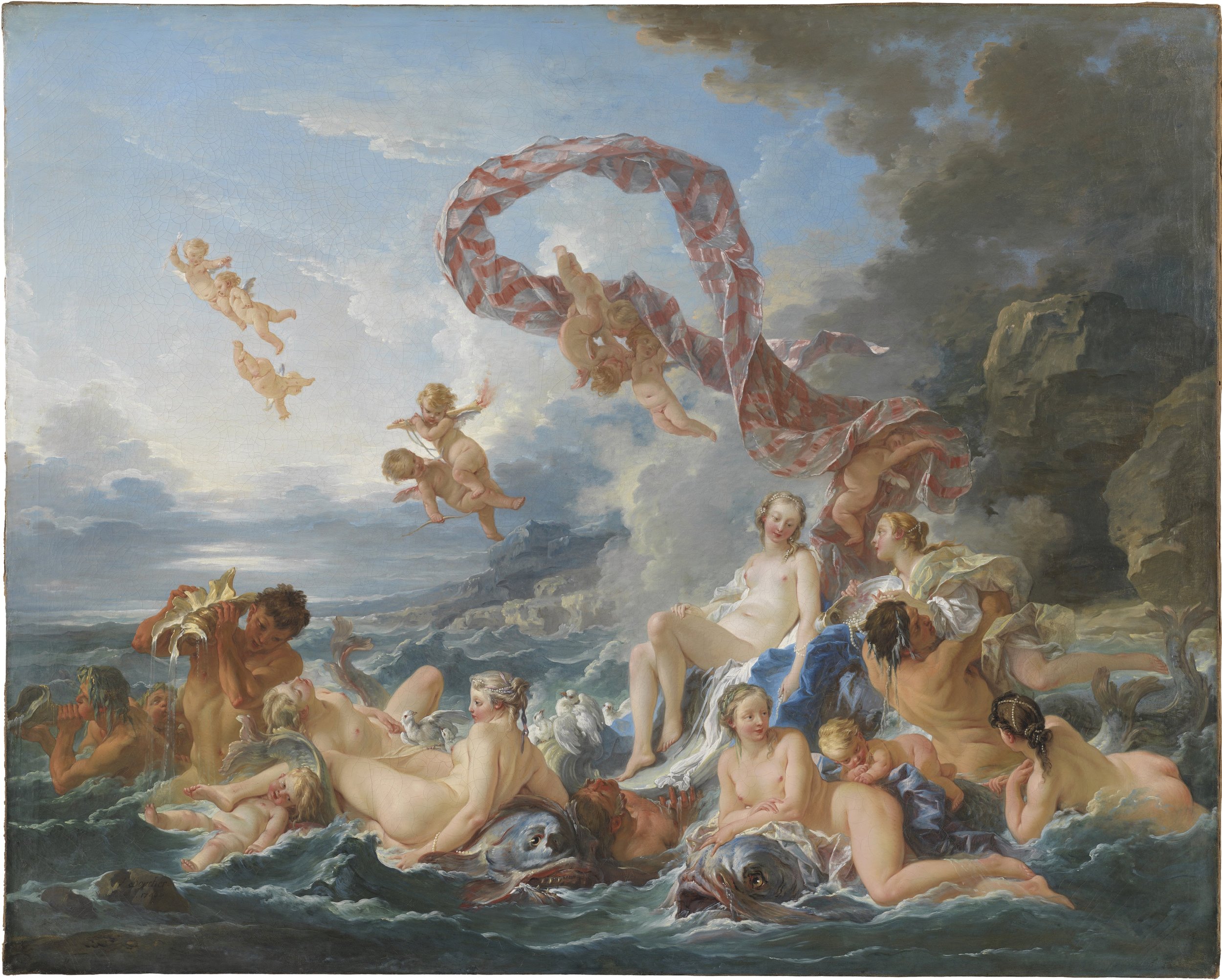
From The Birth of Venus to the Generative Image
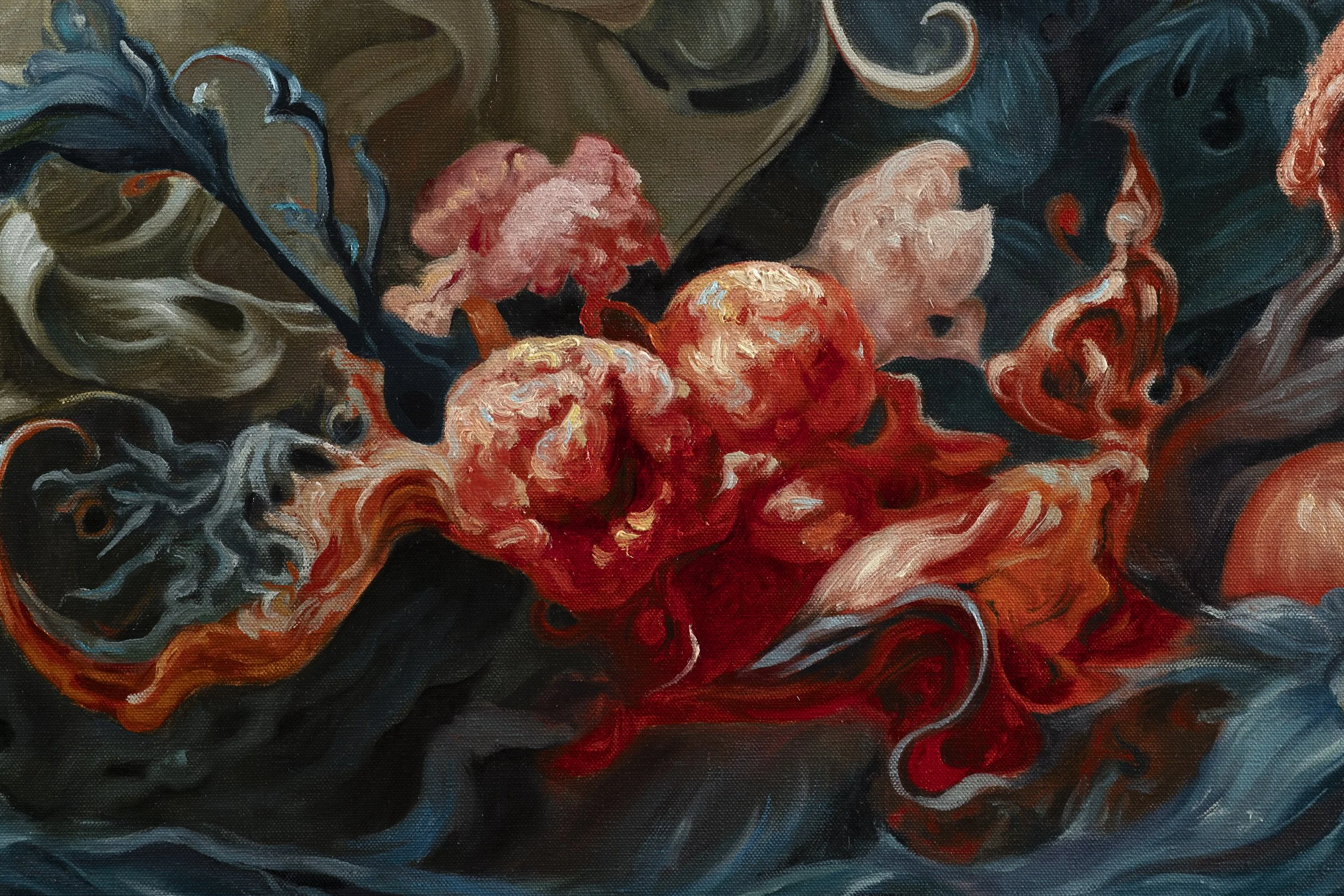
This project began with a refusal. Somewhere between the screen and the hand, the nude became a problem to be managed: cropped, softened, displaced, translated into forms that could pass. Aphantasia follows that tension. Drawing from art history, generative systems, and the slow labor of painting, these works trace what happens when desire meets a regime of permissions. Flesh turns into foam, drapery, shell, flower, glare. The image is not erased; it is taught to hide. Painting does not restore innocence here. It gives weight, time, and surface back to what the feed makes light.
Common Ground
Before the figure, there was residue. For years, Mil mesetas has gathered the surplus of painting that never reached its assigned canvas: leftover mixtures, blooms of color, traces of the hand, displaced matter that, rather than being scraped away, is allowed to remain. What would usually be treated as excess is kept, accumulated, and left to thicken into a surface that is no longer background but form. Each deposit holds a duration of its own: accident, labor, correction, hesitation, time.
Within Aphantasia, this ongoing drift functions as common ground: a shared repository, fed by the studio’s own traffic of matter, where the image has not yet appeared, but painting already insists. If the other works move through prohibition, substitution, and the managed visibility of desire, Mil mesetas stays with what precedes and outlasts the figure: sediment, entropy, the slow pressure of matter. It does not represent the body. It gathers the body of painting itself—collective, aleatory, and stubbornly present.
This body of work did not emerge from revelation, but from a boundary. A screen refused an image, and from that refusal the project began to learn its own conditions: what could appear, what had to be veiled, what returned only by way of substitution. Each work marks a distinct threshold in that education—denial, rehearsal, detour, staging, encounter, shared presence. Together they form a diary, not of solved images but of images made under pressure, where every permission carries a cost and every omission leaves a residue. What follows is less a sequence than a field of passages: a record of how painting slows, thickens, and renegotiates what the screen would rather keep light.
A Journal of Permissions and Omissions
The Denied Image
Still Morte I: Jardín de las delicias begins at a threshold already loaded with precedent. Art history has long offered the body a conditional entry: it may appear if clothed in myth, allegory, or culture. Passed through generative systems, that inheritance becomes a checkpoint. The nude is not refused with scandal but with administrative calm—filtered, corrected, taught to pass. Prohibition begins here, not as spectacle, but as protocol.
Learning the Perimeter
These early studies mark the moment when the project learns the fence. They are not sketches in the academic sense, but exercises in inverse translation: carrying what is born on screen back into matter, and teaching speed to slow down. Here the question is no longer simply what may be shown, but how much can remain, what must be displaced, which traces of flesh trigger refusal. Censorship stops behaving like an external ban and becomes texture, rhythm, anticipation. The image begins to correct itself before it fully appears.
Passport for the Body
In Et in Arcadia Ego, death enters where flesh hesitates. The skull moves through the image with an ease the body no longer enjoys: it is symbol, history, authorized matter. Beside it, the octopus insists on another kind of intelligence—soft, tactile, vulnerable, unable to harden without losing itself. The painting stages a paradox that runs through the series: sometimes desire returns to visibility only when escorted by death. Here, mortality becomes a passport for the body.
Private Theater
With El susurro de Heliogábalo, the image is no longer negotiated only with the machine. It is staged, lit, and composed by hand, like a private altar assembled without permission. Roses, feathers, pelican, cat, ornament, and fracture enter the same scene with deliberate artifice. What matters here is not fantasy as escape, but fantasy as construction. After so much correction and filtering, the project remembers that invention can still be intimate, and that artifice may arrive as a clandestine pleasure.
Witnessing a Presence
With Ía, Safo y Siboney o la ligereza del malaquita and its accompanying studies, the project moves away from the logic of platforms toward something more exposed: the task of corresponding to a presence. The name itself seems to fold technology back into the scene, yet what matters here is not concept but proximity. The portrait is no longer about solving an image, but about listening to someone’s way of inhabiting the world. Myth, domesticity, pigment, and vulnerability meet without collapsing into one another. The work does not denounce the artificial; it affirms what has been offered.
The Shared Body
Amor Vincit marks one of the project’s decisive turns. Working from a live model changes the rhythm, the ethics, and the kind of truth painting can hold. The body is no longer downloaded, cropped, or inferred from a screen; it is shared in time, with breath, fatigue, temperature, and the return of the gaze. What had been archetype becomes encounter. The painting no longer negotiates only with visibility. It negotiates with presence itself.
Still Morte: The Grammar of Venus
The title Still Morte comes from a memory that predates this project’s current form. In 2014, after presenting a group of portraits abroad, I had the chance to visit Vera Mercer’s studio through Humberto Chávez Mayol. Among flowers, taxidermy, and animal remains, delicacy and abjection shared the same air without hierarchy. There I came across a catalog for an exhibition titled Still Morte—Mercer’s work, curated by Humberto—and the phrase stayed with me. Neither quite English nor French, it seemed to hold two conditions at once: still life and nature morte, suspended beauty and the certainty of decay. What it named was not death as spectacle, but the uneasy lucidity with which life, once arranged before the eye, begins to negotiate with disappearance. That tension has remained central to this project.
Returning to Venus was a way of entering that negotiation through one of the most persistent figures in the history of images. Venus is not an innocent origin, but a learned grammar of looking: a system through which Western painting has long authorized the nude by way of myth, allegory, ornament, and idealization. Shell, wave, drapery, pearl, blush, luminous skin—these are not merely decorative elements, but permissions. They teach the eye how desire may become visible, and under what terms. To work with Venus inside Aphantasia meant taking that inherited archive and passing it through a contemporary regime of visibility: generative systems trained on the history of representation, yet governed by platform moderation and automated suspicion. The machine recognizes the canon; the platform still hesitates before the body.
That hesitation is where these paintings begin. The nude does not disappear; it is displaced. Where flesh should emerge, substitutes arrive: foam, fabric, shell, bloom, glare, nacre, a soft oval of light. Censorship does not erase desire so much as instruct it to hide inside composition. This is why the Venus works continue to expand across multiple historical variants: Artemisa, Botticelli, Boucher, Titian, Rubens, Cabanel, Bouguereau, and others do not function here as citations to be admired from a distance, but as different grammars of permissible seduction. Each one offers a distinct threshold between revelation and concealment, between the body as promise and the body as managed surface. Painting enters after that displacement has already occurred. It does not restore innocence to the image; it gives density, time, and material consequence to what was filtered, softened, or made to pass as something else. In that sense, Still Morte names the project precisely: beauty under pressure, desire in negotiation, and the body surviving by metamorphosis.
Essays on Displacement
These early studies do not function as preliminary sketches so much as records of pressure. Here, the body is not yet recovered; it is negotiated. Skin drifts toward ornament, atmosphere, and substitute—shell, fold, glare, bloom. What appears is not the nude itself, but the set of permissions through which the nude may still circulate.
François Boucher
With Boucher, Venus becomes theater. Drapery, nacre, blush, wave, floral excess: the body is not simply revealed, but staged through a choreography of permission. Passed through generative systems and returned to painting, that promise fractures. The figure does not vanish; it becomes indirect, displaced into surface, softness, and ornament. The final painting gathers that tension: not the recovery of an original nude, but the material consequence of its managed appearance.